From gameplay to pedagogical insight
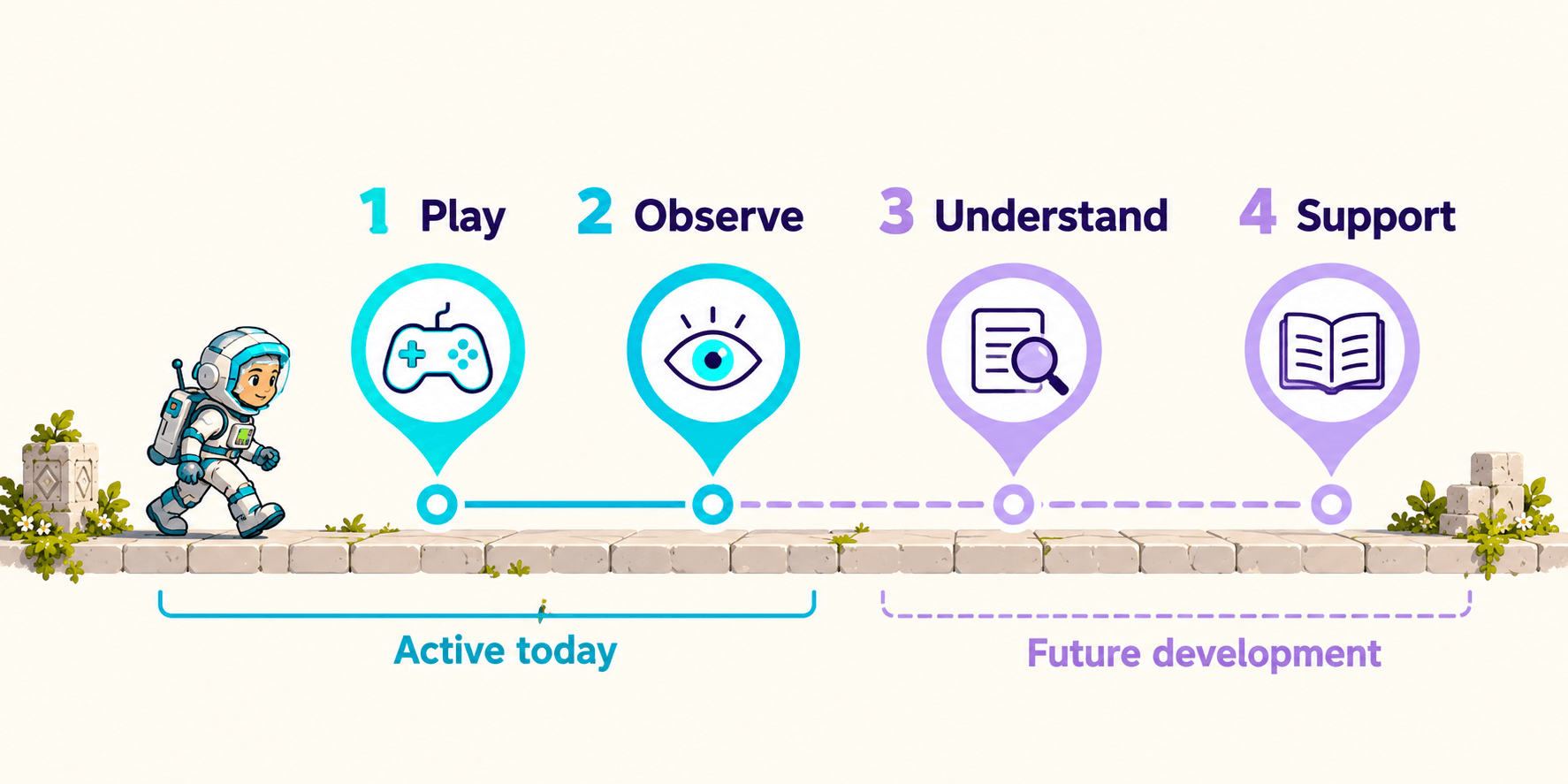
How can observations from a digital adventure become useful to the adults supporting a child’s learning? Ludinautes is developing this connection in three phases, beginning with active data collection and working towards meaningful analysis and future pedagogical support.
Why the journey goes beyond the game
For a child, Ludinautes begins with an adventure: a world to explore, missions to undertake and challenges to navigate with others. For the adults around that experience, a different question emerges. What might those moments eventually help us understand about learning, and how could that understanding inform the support we offer?
Connecting these perspectives is a central ambition of Ludinautes. The game creates opportunities to mobilize learning-related skills; the developing educational infrastructure aims to make observations from play useful beyond the screen. Moving between the two requires care. A successful action in a game does not, by itself, demonstrate a lasting ability, just as a difficult moment does not establish a learning difficulty.
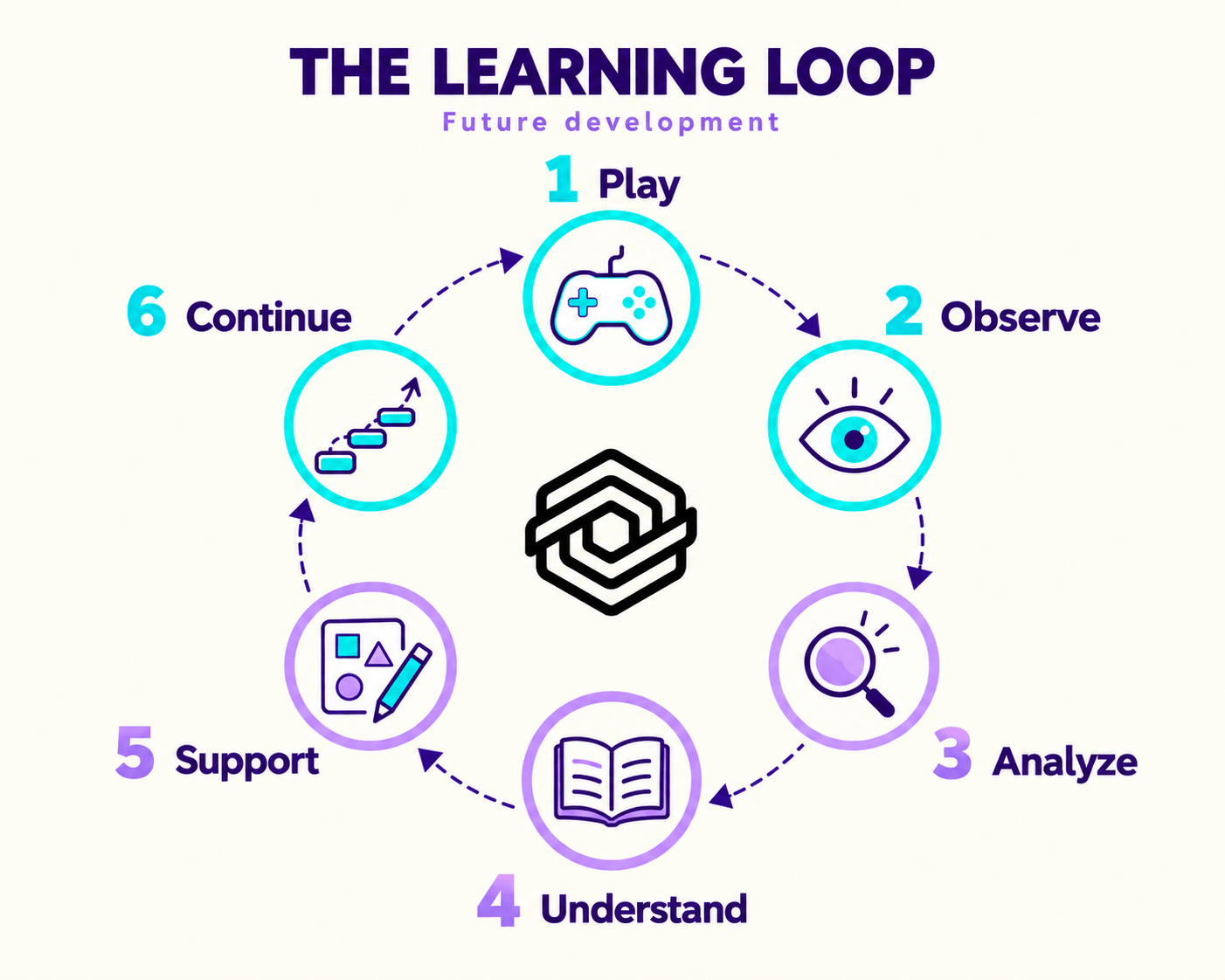
The intended connection is a learning loop: play, observation, analysis, pedagogical understanding, suggested support and continued learning. Today, this is a development objective. The complete loop is not operational.
Progress towards it depends on three distinct phases. Data collection is active. Analysis and pedagogical support remain future stages, each requiring foundations that cannot be skipped. For teachers, researchers, parents and institutional partners, understanding these boundaries is essential to understanding both the project’s direction and its present limits.
Phase 01: Building the foundations through observation
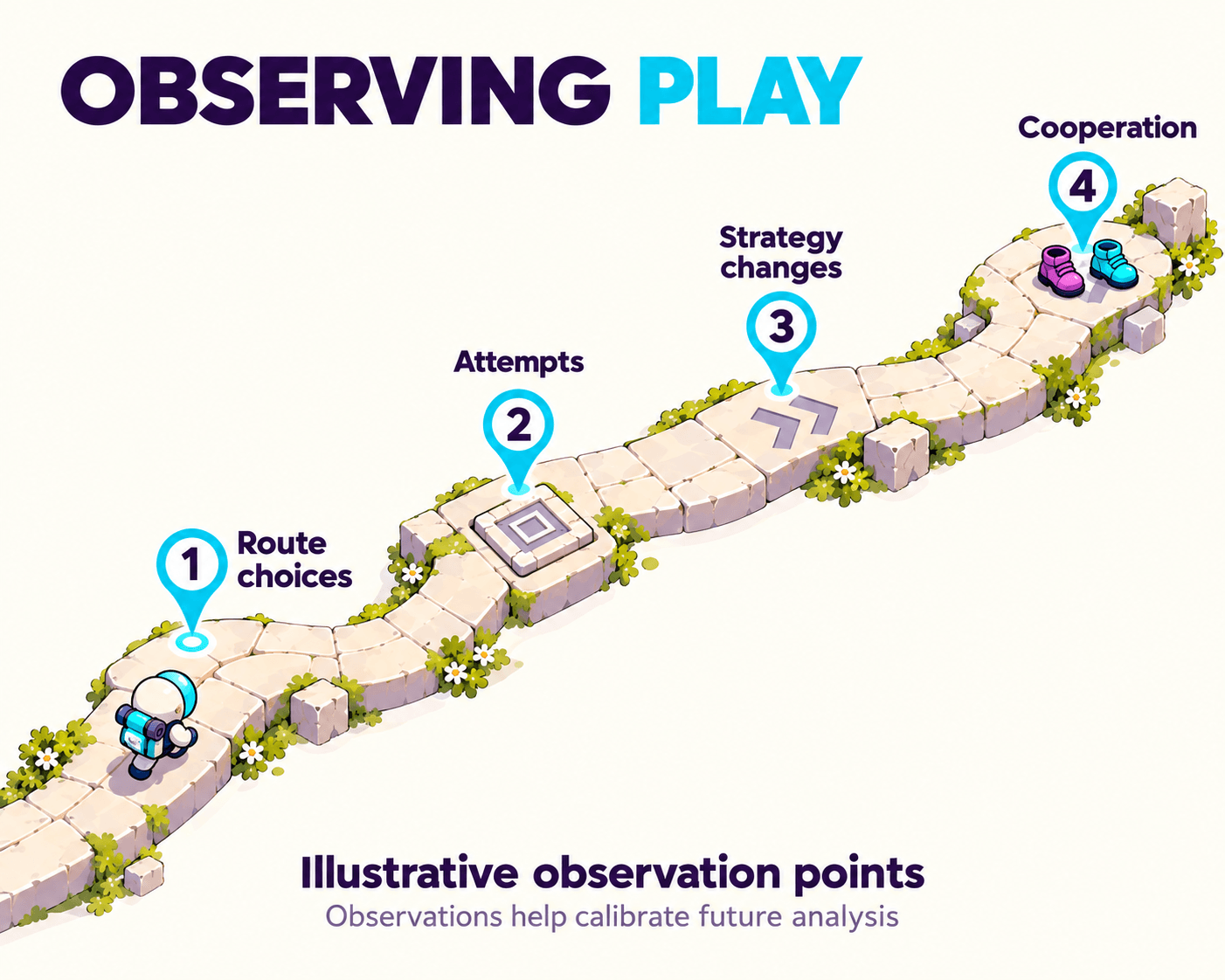
Gameplay sessions already transmit observations. At this stage, those observations are not associated with an identified individual player. Their purpose is to help calibrate and refine the tools and methods needed for future analysis. This first phase is about building the foundations for interpretation.
Collecting observations makes it possible to begin examining what information gameplay can provide and what further work is needed to make it useful. It does not yet tell us what an individual child has learned. These observations are neither personalized learner profiles nor validated assessments, and they should not be read as clinical measurements.
Consider, for example, the interpretation of repeated attempts at a challenge. Depending on the situation, repetition might reflect exploration, uncertainty or a deliberate search for another solution. The observable action alone cannot settle the question. Its meaning depends on the challenge, the surrounding circumstances and the limits of the method used to interpret it.
That is why collection is an important first step, but an insufficient basis for conclusions about progress or ability. The immediate value lies in developing better tools and questions. Any future educational interpretation will need to earn its credibility through further work.
Phase 02: Turning observations into meaningful insight
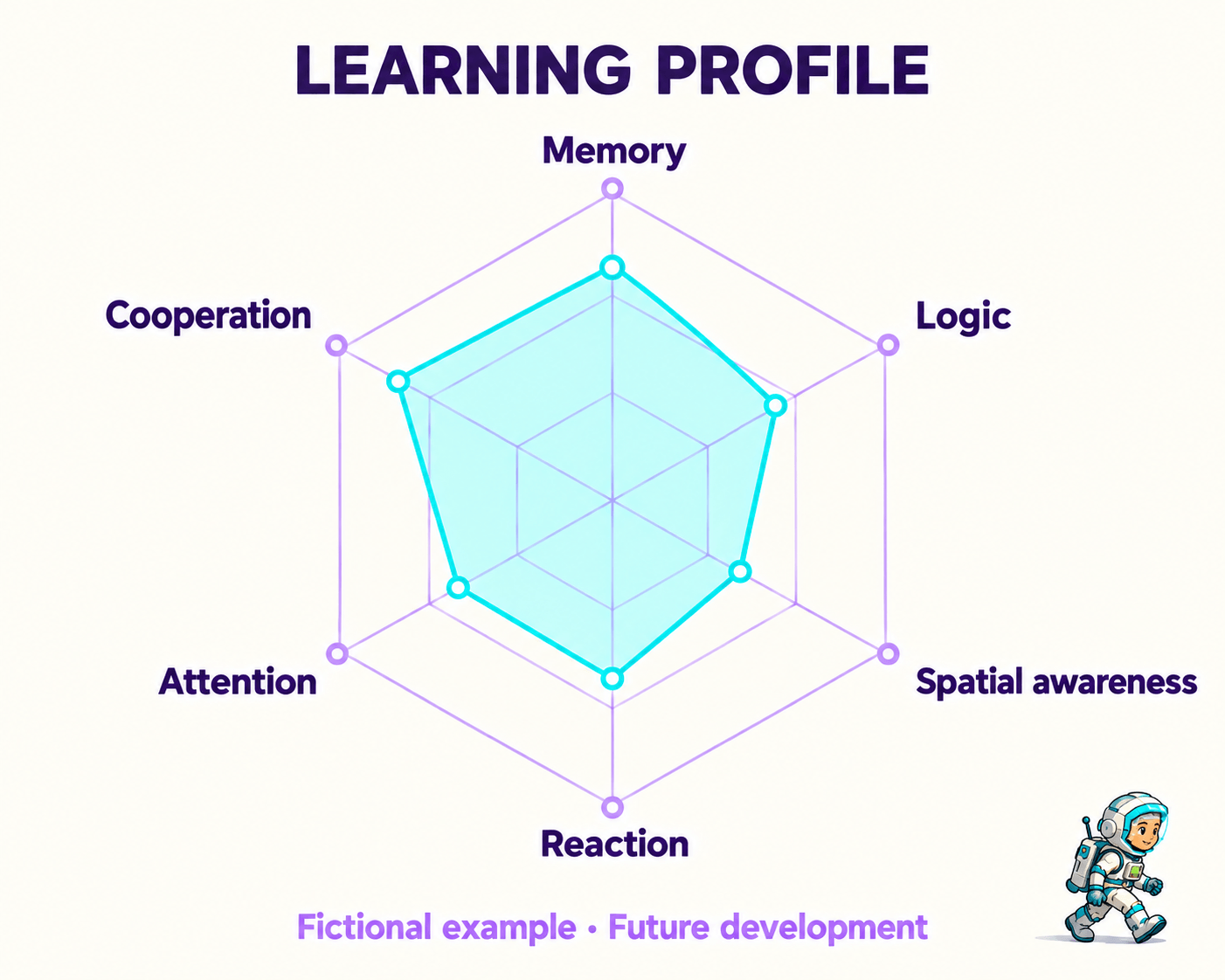
The next phase will address a more demanding task: giving observations meaning. Data analysis is not yet operational. The ambition is to develop sufficiently reliable methods so that collected information may eventually contribute to indicators of progression, progressively made visible in Ludinautes profiles.
Reaching that point requires more than arranging data into an attractive display. An indicator needs a clear interpretation: what does it describe, under which conditions is it informative, and where might it mislead? A change in gameplay behaviour could reflect greater familiarity with the game rather than a change in the learning-related skill being explored.
Analytical methods will therefore need calibration and scrutiny. Their reliability must be assessed, their assumptions examined and their limitations made understandable. Apparent patterns should prompt questions before they become conclusions. Raw observations do not automatically become pedagogical knowledge when they pass through an analytical tool.
The aim is to offer adults information they can interpret responsibly, with enough context to understand its scope. Operational individual dashboards, automated interpretations and validated progression indicators are not current capabilities. Establishing useful indicators remains a development task, and communicating uncertainty will be part of making them useful.
Phase 03: Towards a learning loop guided by people
The longer-term goal is to connect meaningful analysis with practical educational support. If sufficiently reliable interpretations can be developed, they could help adults better understand a child’s development and identify areas where additional support may be useful. This phase is future work and is not yet operational.
Possible forms of support include suggestions for educational activities, printable pedagogical resources and more personalized learning pathways. These would extend the connection beyond the game, allowing a digital adventure to inform an activity, conversation or learning opportunity in another setting. AI-supported suggestions and individualized remediation belong to this future ambition; they are not available capabilities today.
Human judgment remains central to that vision. Parents, teachers and educational professionals bring knowledge of the child and their circumstances that gameplay observations alone cannot provide. They must retain responsibility for deciding whether a suggestion is appropriate, how to adapt it and when a different approach is needed.
Ultimately, the learning loop should create a useful relationship between play and the people supporting learning. Ludinautes is beginning with observation, working towards interpretation and keeping practical support as its longer-term direction. Each connection will need to be developed and evaluated before the whole can fulfil its purpose.